

THE BRAIN OF PRESENCE - When Neuroscience Rediscovers Something Obvious

Updated: Jul 1
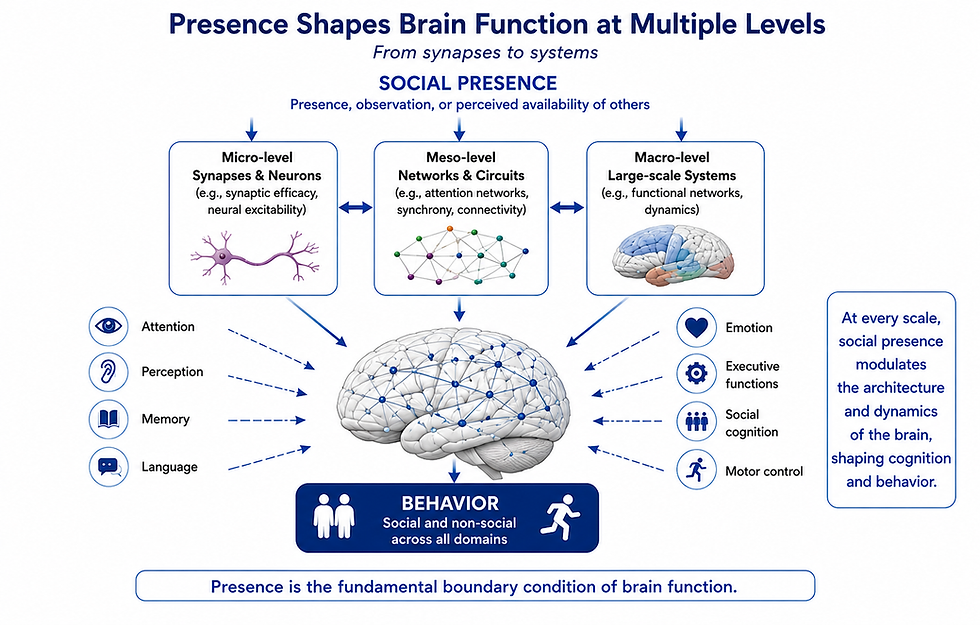
The mere presence of others alters how neurons recruit, how brain networks organize, and how cognition unfolds—without interaction, communication, or shared intention. This is the starting point of the project "The Brain of Presence" : to treat social presence not as a context, but as a foundational condition of brain function. Neuroscience, clinical practice, development, and civilizational dimensions.
The experience that everyone knows
You enter a room. You don't yet know if it's empty. Something in your attention shifts before you've even looked. Then you realize that someone is there—or that no one is. This micro-experience is commonplace. Yet it lies at the heart of a question that neuroscience has long neglected.
We all know the difference between being alone and being silent with someone. In an elevator, a waiting room, a library, no one speaks, sometimes no one even looks at each other. Yet, the silence is no longer the same. Something has already become social.
Attention subtly reorganizes. Self-awareness becomes slightly more acute. The body settles into a different rhythm.
It is this observation, both obvious and largely unnoticed, that is at the starting point of the "Brain of Presence" project. Not an abstract theory, but a concrete question: what does your brain do before the relationship begins?
What the social brain has brought — and where it stops
For the past thirty years or so, social neuroscience has accomplished something remarkable. It has shown that the human brain is equipped with networks specialized in processing social information: perceiving the emotions of others, understanding their intentions, putting oneself in their shoes, and regulating one's own responses in a relational context. This program—often called the "social brain"—has led to major advances.
But this framework has a limitation, and it's structural. By focusing on social cognition—empathy, theory of mind, communication, interaction—it always begins after something has already happened. After the presence has been registered. After the brain has already reconfigured its networks accordingly.
The social brain explains how we interact with others. But it doesn't tell us what the brain is doing before the interaction begins.
It is this more fundamental level that the "Brain of Presence" project seeks to explore. Not by replacing the social brain, but by asking a question that precedes it: where does sociality begin in the brain?
Presence first — the heart of the project
The central idea is simple, even if its implications are far-reaching. The mere presence of another person—without interaction, without communication, without shared intention—alters the way the brain functions. This is not experimental noise. It is not one context among others. It is a condition that organizes cognition itself.
The brain does not start from a "neutral, solitary" state to which it adds a social layer. It is already configured by the presence or absence of others. Depending on whether someone is there or not, the same neuronal populations are mobilized, the same networks are organized, and the same attentional resources are deployed.
The project proposes to treat social presence as a fundamental variable in brain function—on par with attention or arousal. Not simply a context noted on the margins of experiments, but a dimension without which models of cognition remain incomplete.
Presence is not something added to cognition. It is one of the conditions in which cognition is organized.
This framework is supported by a scientific article recently made available open access on OSF/PsyArXiv, and by a second, more moderate version submitted to the international journal Frontiers in Psychology. But it goes beyond these two texts: it is the guiding thread of a platform, a book in preparation, and a series of articles in French.
What the research shows — in plain language
Three sets of results, from recent work in neuroscience, provide empirical support for this proposition.
"Social" and "asocial" neurons. Marie Demolliens recorded the activity of neurons in the prefrontal cortex of primates while they performed a learning task—exactly the same task, alone or in the presence of another member of their species. The result: most of the recorded neurons were sensitive to the social context. Some preferred presence, others isolation. And each group predicted better performance in its preferred context. The task itself was asocial. It was the brain that was already configured for presence.
Brain networks reorganize themselves. Imaging studies show that the presence of a peer alters the organization of attentional networks on a large scale—not a generalized increase in activation, but a functional reconfiguration. It's not "a little more arousal." It's a different processing architecture.
Increased synaptic efficiency. Recent work, published in Communications Biology, has shown that social presence is associated with an increase in excitatory synaptic efficiency—down to the level of the individual synapse. The presence of others literally changes the way neurons communicate with each other.
These results are not anecdotal. They suggest that social presence is not a "contextual factor", but a structuring variable at all levels of brain organization — from behavior to the synapse.
What this changes — for clinical practice, development, and everyday life
If presence organizes cognition, then several familiar questions arise differently.
In clinical practice, social anxiety, derealization, and hypervigilance can be interpreted not only as problems with the cognitive processing of social information, but also as dysfunctions in the estimation of presence itself. The system undervalues a real signal, or overvalues an insufficient one—and this error in estimation governs everything that follows.
As a child's brain develops, it doesn't build itself in a social vacuum. It calibrates itself in a world populated by others whose presence is more or less reliable, more or less predictable. What I call "stories of presence"—the cumulative trace of our experiences of presence and absence—leaves lasting imprints on the system's sensitivity.
In everyday life, why do we work differently in an open-plan office and at home? Why is a telemedicine consultation not the same as an in-person consultation? Why does the presence of a loved one change our experience of pain or stress? Presence is not a qualitative variable added to processes that would be the same without it. It is an integral part of them.
Presence has many faces — and many scales
The "Brain of Presence" project explores this question on several dimensions, some of which will be developed in future articles.
The biological roots of presence. Sensitivity to the presence of another member of one's species did not begin with Homo sapiens. It is found in primates, rodents, social insects—and even in bacteria. Quorum sensing is a mechanism by which a bacterial colony only changes its behavior when a presence threshold is reached. Before the brain, before the nervous system, there was already the question: Is there anyone else here?
Artificial presence. What happens when the other person isn't human? Humanoid robots modify cognitive performance in ways similar to a human observer—under certain conditions. Does conversational AI create a form of presence? These questions are no longer theoretical.
Development and histories of presence. Repeated experiences of presence and absence throughout life—whether nurturing, unpredictable, or traumatic—shape the system's sensitivity to presence throughout life. Attachment, loneliness, isolation, and grief can all be understood from this perspective.
The civilizational dimension. We are experiencing a historic transformation of the conditions of presence. Remote work, screens, telemedicine, and social networks are radically altering the landscape of presence in which our brains function. A society that removes physical presence without understanding the neurological consequences is taking a risk it cannot yet fully grasp. This is perhaps one of the most urgent scientific and political questions of our time.
Detecting the presence of the other: a biological mechanism conserved from bacteria to the human cortex. Not a metaphor. A fact of life.
psy-monde.com — and more
The "Brain of Presence" project is supported by several complementary resources. The open-access scientific article, available on OSF/PsyArXiv, lays the theoretical and empirical groundwork for a readership of researchers and clinicians (link at the bottom of the page). The psy-monde.com platform is a space for popularization and in-depth exploration in French—for those who want to understand without necessarily reading a scientific article. A book is in preparation.
The following articles will explore each of the themes mentioned above: presence and anxiety, the evolutionary roots of presence, artificial presence and AI, presence in child development, and the civilizational dimension of our digital transformation.
If you recognize something of your own experience in these questions — as a clinician, as a researcher, or simply as someone who is attentive to what happens in a room when someone enters it — welcome to this project.
References
Boussaoud, D. (2026). The Brain of Presence: A Foundational Framework for Social Neuroscience. OSF/PsyArXiv preprint. osf.io/preprints/psyarxiv/tpnze_v2
Demolliens et al. (2017). Social and asocial prefrontal cortex neurons: a new look at social facilitation and the social brain. Social Cognitive and Affective Neuroscience, 12, 1241–1248.
Monfardini et al. (2016). Others' sheer presence boosts brain activity in the attention (but not the motivation) network. Cerebral Cortex, 26, 2427–2439.
Tricoche et al. (2025). Neural bases of social facilitation and inhibition. Social Cognitive and Affective Neuroscience, 20, nsae079.
Esmaeili et al. (2025). Probabilistic inference of social presence across brain scales reveals enhanced synaptic efficacy. Communications Biology, 8, 1608.
Articles and links to explore
General presentation of the project and the question that constitutes its starting point.
How social neuroscience has transformed our understanding of the brain, and why the question of presence could complement this theoretical framework.
Why certain ordinary experiences — shared silence, feeling watched, soothing or threatening presence — can help us understand the role of presence in human experience.
In an elevator, a waiting room or a train, the mere presence of another person is often enough to transform our experience.
How attachment theory can be reinterpreted in light of presence.
Videos, reflections and explorations around the neuroscience of presence, attachment, development and psychotherapy.
Dr. Driss Boussaoud — The Brain of Presence


Comments