


Why do some people naturally feel safe in their relationships, while others live with the fear of being abandoned, rejected, or overwhelmed?
Why do some find it easy to ask for help when going through a difficult time, while others prefer to handle everything alone, even when they're suffering?
Attachment theory, developed by John Bowlby and Mary Ainsworth, has profoundly transformed our understanding of human development.
It shows that our earliest relationships aren't just important for a child's emotional well-being. They actively participate in building the brain itself and durably influence how we perceive ourselves, how we perceive others, and how we enter into relationships.
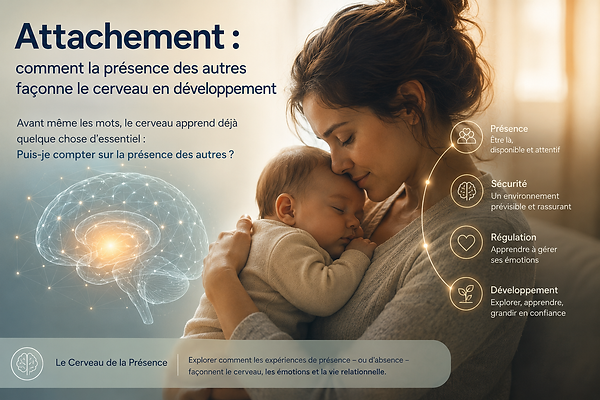
But even before words, even before memories, the brain already learns something more fundamental:
Can I count on the presence of others?
Attachment could be understood as one of the ways the brain progressively answers this question.
Attachment begins long before words
The infant doesn't yet understand language. Yet their brain is already learning enormously about the world around them.
Through gazes, voices, gestures, physical closeness, and responses to their needs, they progressively discover whether the human world is predictable or not, reassuring or worrying, available or absent.
Does someone respond when they cry? Does someone notice their distress? Can they count on a presence that helps them regain their balance when they're overwhelmed?
Through thousands of daily experiences, the brain progressively builds an implicit representation of the world and its own place within it.
This representation doesn't rest solely on what is said or done.
It rests first on a repeated experience of presence.
The brain develops in presence
Brain development never occurs in a vacuum.
From the earliest months of life, relational experiences profoundly influence how the child learns to regulate their emotions, cope with fear, explore their environment, and develop an inner sense of security.
When an adult calms a frightened child, they aren't simply comforting them in the moment. They're contributing to the progressive construction of the brain systems that will later allow this child to regain their own balance.
Emotional security is therefore not only a psychological state.
It results from biological, relational, and developmental learning.
From this perspective, the human brain never develops alone.
It is built in presence.
When presence becomes safety
When a child grows up in an environment where adults are generally available, attentive, and predictable, they generally develop what is called secure attachment.
This doesn't mean everything is perfect.
It simply means that, most of the time, the child experiences a world in which others are accessible when needed.
This experience fosters self-confidence, trust in others, exploration, autonomy, the capacity to ask for help, and better emotional regulation.
Inner security is progressively built from these repeated experiences.
When presence becomes uncertainty
In other situations, early experiences can be more complex.
Attachment figures may be emotionally unavailable, unpredictable, sometimes present and sometimes absent, or themselves overwhelmed by their own difficulties.
The child's brain then adapts to this environment.
Some people become particularly sensitive to signs of rejection or abandonment. Others learn to minimize their emotional needs and rely only on themselves.
These adaptations are often intelligent within the context in which they developed.
But they can become harder to live with in adulthood when they continue to influence relationships even after the context has changed.
Attachment throughout life
Contrary to a common belief, attachment is not fixed in childhood.
The brain retains a remarkable capacity to learn from new relational experiences.
Romantic relationships, friendship, parenthood, certain professional experiences, but also psychotherapy, can progressively modify one's inner sense of security.
The models built in childhood influence our relational life, but they don't definitively determine our future.
Early experiences often continue to influence the way we relate to others long after childhood. This is why attachment-related questions remain relevant throughout adult life.
Toward greater inner security
Understanding one's attachment style isn't about pinning on a label.
It's rather about better understanding how certain life experiences have shaped the way we relate to ourselves and to others.
This understanding can be a first step toward greater security, freedom, and relational flexibility.
Because the brain remains capable of changing throughout life.
And every sufficiently secure relational experience can contribute to this evolution.
How I work
Each person arrives with their own history, experiences, and particular ways of protecting themselves when they feel in difficulty. These strategies were often useful at some point in life, but they can become a source of suffering when they repeat automatically.
My approach draws notably on schema therapy, which seeks to understand how certain early relational experiences have shaped the way we perceive the world, others, and ourselves.
Together, we work to identify the emotional needs that haven't always been met, the schemas that developed to adapt to these situations, the automatic reactions that maintain certain difficulties today, as well as the resources that allow for greater security, flexibility, and freedom.
I also integrate tools from EMDR, ACT (Acceptance and Commitment Therapy), and the neuroscience of emotional regulation.
The goal isn't only to understand what's happening, but to allow the nervous system to progressively regain a sense of security, stability, and presence to oneself.
To go further
Emotional regulation doesn't depend solely on what happens inside us. Since birth, our brain develops and functions within a deeply relational environment.
The quality of the presences that surround us — their availability, their stability, their capacity to reassure or understand us — profoundly influences our emotional balance, our energy levels, and our capacity to cope with stress.
The role of presence in development, attachment, emotional regulation, and psychotherapy is at the heart of the project The Brain of Presence, an exploration at the crossroads of neuroscience, attachment, and clinical practice.
Related sources
Depending on your situation, you may wish to consult the following pages:
-
EMDR – Understanding how the reprocessing of difficult memories can support psychological healing.
-
Trauma – Better understanding the consequences of simple or complex psychological trauma.
-
Attachment – Understanding how the brain gradually learns whether it can rely on the presence of others.
-
Borderline Personality Disorder – Understanding the difficulties of emotional and relational regulation.
-
Anxiety – Understanding the mechanisms of worry, hypervigilance, and panic attacks.
-
Depression – Exploring the link between psychological exhaustion, loss of momentum, and a sense of disconnection.
-
Couples Therapy – Understanding relational dynamics and attachment difficulties within the couple.
-
Consultations – Practical information on consultations in Marseille or via teleconsultation.
Contact and appointment booking →
For a deeper exploration of the neuroscience of presence, you can also visit The Brain of Presence section.